Definition of Feeder in Beef Production

Fatty cattle and alfalfa in the Pecos Valley, New United mexican states (probably early 20th century)
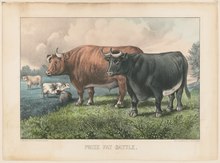
"Prize fat cattle" (probably late 19th century)

The 1000 Champion steer at the 13th annual Fat Cattle Auction and Show in Quincy, Florida, 1959
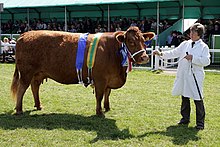
Foxhole Martha; 2005 Royal Cornwall Female person Brood Champion
Feeder cattle, in some countries or regions called shop cattle, are young cattle mature plenty either to undergo backgrounding or to be fattened in preparation for slaughter. They may be steers (castrated males) or heifers (females who have non dropped a calf). The term often implicitly reflects an intent to sell to other owners for fattening (finishing). Backgrounding occurs at backgrounding operations, and fattening occurs at a feedlot.[1] Feeder calves are less than one yr old; feeder yearlings are betwixt one and two years old. Both types are often produced in a cow-dogie operation. Later attaining a desirable weight, feeder cattle go finished cattle that are sold to a packer (finished cattle are too called fattened cattle, fat cattle, fed cattle, or, when assorted with carcasses, live cattle). Packers slaughter the cattle and sell the meat in carcass boxed form.[2]
Feedlots producing live cattle for slaughter will typically purchase 500–850 pounds (230–390 kg) feeder cattle calves and feed to grow the animals into 850–1,400 pounds (390–640 kg) cattle.[iii] [2] Backgrounding operations will typically purchase 300–600 pounds (140–270 kg) feeder cattle calves and feed to abound the animals into 650–875 pounds (295–397 kg) backgrounded cattle. Backgrounding cattle that accomplish weights of 650–700 pounds (290–320 kg) are suitable for sale to grass feeding operations, whereas those achieving weights of 800–825 pounds (363–374 kg) are suitable for sale to feedlot operators.[four] Buyers of feeder cattle tend to wait for high average gain (in weight) and low feed-to-gain ratio. Depending on circumstances, different feeder cattle buyers volition look for different ranges of animate being weight and course.[five]
Cattle producers and backgrounding operations residuum feeder cattle prices, weights, time taken to fatten, death rates, and other feeder cattle factors against feed prices, alive cattle prices, and other operating factors to profit from their operations.[6] [iv]
United states of america feeder cattle grades [edit]
The United states grades feeder cattle that take not reached an historic period of 36 months on iii factors: frame size, thickness, and thriftiness.[7]
- Frame size evaluates feeder cattle' superlative and torso length every bit determined past their skeletal size in relation with their age; frame size affects the animals' mature size and weight gain composition as they are fed into fed cattle. A large framed feeder cattle of a given age, brood, and a given degree of thickness will gain more musculus and bone, and less fatty, than a smaller framed animal with the same age, breed, and thickness at a given maturity age. In terms of United States Department of Agronomics (USDA) grades for cattle carcasses, at a given weight and thickness, large framed cattle (fed from big framed feeder cattle) will have carcasses with higher yield grades, but lower quality grades. If feeder cattle are fed to the same quality grade, Pick (0.fifty inches (13 mm) fat at the twelfth rib) for example, large framed cattle of a given thickness have to exist fed to heavier weights than smaller framed cattle of the same thickness. Age and breed modifies the precise sizes that segment this form.
- Big frame feeder cattle are alpine and long-bodied for their age and breed, and steers and heifers of this frame, everything else being constant, are not expected to produce U.s.a. Choice until they are fed to 1,250 pounds (570 kg) and 1,150 pounds (520 kg), respectively.
- Medium frame feeder cattle are slightly alpine and slightly long-bodied for their historic period and breed, and steers and heifers of this frame, everything else being abiding, are not expected to produce Usa Selection until they are fed to 1,100 to 1,250 pounds (500 to 570 kg) and one,000 to 1,150 pounds (450 to 520 kg), respectively.
- Small frame feeder cattle are shorter and non every bit alpine for their historic period and breed compared to medium frame feeder cattle, and steers and heifers of this frame, everything else beingness abiding, are not expected to produce U.s. Choice until they are fed to 1100 pounds and grand pounds, respectively.[7]
- Thickness evaluates feeder cattle' muscle evolution in relation to skeletal size. Os structure, muscling, and caste of fatness determines differences in thickness. Thicker cattle accept higher ratios of muscle to bone. Thickness affects the animals' yield form as they are fed into fed cattle, and a thick feeder cattle of a given age, breed, and frame size will produce a higher yield grade carcass, than a less thick animal of the same historic period, breed, and frame size at a given maturity age. If feeder cattle are fed to the same quality grade, Option for example, thicker feeder cattle of a given thickness have to be fed to heavier weights than less thick feeder cattle of the same thickness. Age and breed modifies the precise sizes that segment this grade. Thickness are graded No. one to No. four.
- No. 1 thickness cattle must be at to the lowest degree moderately thick throughout their bodies, full in the forearm and the gaskin, and showing a rounded advent through the back and the loin with moderate width between their legs.
- No. 2. thickness cattle must be at least slightly thick throughout their bodies, full in the forearm and the gaskin, and showing a rounded advent through the back and the loin with a slight width between their legs.
- No. iii thickness cattle must be at least sparse through the forequarter and middle part of the rounds, their forearm and gaskin are thin and their backs and loins have a sunken advent, and their both front and rear legs are set up close together.
- No. 4 thickness cattle include whatever cattle with fifty-fifty less thickness than the minimum requirements for No. 3 cattle. No. 1 thickness cattle typically show more often than not beef breeding, No. 2 thickness cattle typically evidence high proportions of beefiness convenance and slight diary convenance, and and so on with lower thickness cattle.[vii]
- Thriftiness evaluates feeder cattle' overall wellness and expected functioning in gaining weight to become a fed cattle. At that place are no strict guidelines equally to grading thrift cattle, rather cattle with apparent health problems are graded as unthrifty and other cattle are categorized equally thrifty.[seven]
The above three factors and their segmented categories combine to form private grades. For examples, for thrifty cattle, the frame and thickness factors combine to form 12 unlike grades of thrifty cattle: No. 1; Large Frame, No. two; Big Frame, No. 3; Big Frame, No. iv; Medium Frame, No. i; Medium Frame, No. 2; Medium Frame, No. 3; Medium Frame, No. 4; Small Frame, No. 1; Small-scale Frame, No. 2; Minor Frame, No. iii; and finally Pocket-size Frame, No. four.[vii]
Cash market factors [edit]
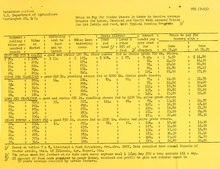
Price to pay for feeder steers in order to receive average returns for labor, overhead and profit with assumed prices for fat cattle and feed, with typical feeding programs; U.Due south. Department of Agriculture
Health status, and visual indicators of wellness, tin can give feeder cattle premiums or discounts when sold in auctions. Feeder cattle with expressionless pilus and mud are oft sold at a disbelieve, and those that are classified as "stale" are sold at a discount. Feeder cattle with other obvious physical indicators that would imply sickness are heavily discounted.
The principal sickness encountered in feeder cattle is respiratory sickness. Discounts on sick feeder cattle compensate for their increased risk of death, and lower operation in weight gain even if they recover. Cattle that expect visually "sparse" or "fleshy" are generally given discounts or premiums singled-out from sickness discounts, as these visual traits do not necessarily indicate sickness and could be advantageous in particular feeding scenarios.[eight]
Some feeder cattle are sold with some pre-existing wellness maintenance programs. These programs may include weaning 21 to 45 days before auction, vaccinating for respiratory and digestive diseases, de-horning, castrating, implanting growth implants, treating for external and internal parasites, and starting to switch the feeder cattle to grain-based feed.[9]
Lot size, or the number of feeder cattle for sale in a group, in relation to transportation available, weight, and sale location impact feeder cattle prices heavily. Price per weight increment with lot size and reach a maximum when lot sizes approaches truck-load sizes. As lot sizes exceed truck-load sizes, prices level off and eventually decrease. This represents fewer buyers and available transportation for larger lots of feeder cattle.[10] [eight]
Futures market trading [edit]
Feeder cattle futures contracts, traded on the Chicago Mercantile Exchange (CME), can exist used to hedge and to speculate on the toll of feeder cattle. Cattle producers tin can hedge future buying and selling prices for feeder cattle through trading feeder cattle futures, and such trading is a common part of a producer'south risk management plan.[eleven] Production and marketing contracts for delivering feeder cattle in cash markets could besides include feeder cattle futures prices equally office of a reference price formula.[12]
The contracts are for 50,000 pounds (23,000 kg) of feeder cattle, and call for cash settlement based on the CME Feeder Cattle Index.[13] The minimum tick size for the contract is $0.00025 per pound ($12.50 per contract). Trading on the contract are subject field to cost limits of $0.045 per pound in a higher place or below the previous day'south contract settlement toll. If both of the beginning two listed contract months settle at limit, the daily cost limits for all contract months shall aggrandize to $0.0675 per pound on the side by side business concern twenty-four hours. If neither of the start two listed futures contract months settle at the expanded limit the next business day, daily price limits for all contract months shall revert to $0.045 per pound on the following business concern day.[fourteen] Feeder cattle futures are also traded on the CME Globex Exchange, beneath is the contract specifications for feeder cattle on the Globex exchange.
| Feeder cattle (FCA) | |
|---|---|
| Substitution: | Globex |
| Sector: | Meat |
| Tick size: | 0.025 |
| Tick value: | v USD |
| BPV: | 200 |
| Denomination: | USD |
| Decimal place: | 3 |
Final settlement based on CME Feeder Cattle Index [edit]
Feeder cattle futures contracts are greenbacks settled based on the CME Feeder Cattle Index. The Index inputs are 7-day feeder cattle auction, directly trade, video auction, and Internet sale transaction prices for qualified steers publicly reported from the following twelve feeder cattle producing states: Colorado, Iowa, Kansas, Missouri, Montana, Nebraska, New Mexico, N Dakota, Oklahoma, South Dakota, Texas and Wyoming. Qualified steers must exist between 700 and 899 pounds (318 and 408 kg), and exist in either the Medium and Large Frame #1 or Medium and Big Frame #1–2 feeder cattle grades. Additionally, qualifying steers must not exhibit predominantly dairy, exotic, or Brahman breed characteristics, and must not have an origin outside of the US.[13]
The CME Feeder Cattle Index is calculated using prices reported past USDA'southward Agricultural Marketing Service (AMS). AMS reports number of cattle sold, average cost of sale, and average weight of cattle sold for daily feeder cattle transactions for every US state in 50 pounds (23 kg) segments for each grade segment. For example, dissever average prices and boilerplate weight data are reported for the Medium and Large Frame #1 700–749 pound category, and for the Medium and Large Frame #1 750–799 pound category. The CME Feeder Cattle has eight qualifying reporting segment derived from its qualifying weight and grade standards: Medium & Big #i steers weightinf 700–749 pounds, Medium & Large #1 steers weighting 750–799 pounds, Medium & Large #1 steers weighting 800–849 pounds, Medium & Big #1 steers weighting 849–899 pounds, Medium & Large #1–#2 steers weighting 700–749 pounds, Medium & Large #ane–#2 steers weighting 750–799 pounds, Medium & Big #1–#2 steers weighting 800–849 pounds, and Medium & Large #ane–#two steers weighting 849–899 pounds.[xvi]
The CME Feeder Cattle Index is calculated through the post-obit steps:
- The number of cattle sold is multiplied by the average weight of feeder cattle sold inside each qualifying 50 pound grade category to produce "Full Pounds Sold" for that category
- The number of cattle sold is multiplied past the average weight and the average price of feeder cattle sold to produce the "Full Dollars Sold" for that category
- "Total Pounds Sold" are added together from the eight qualifying reporting categories of each report, and then reports from all 12 states for the terminal 7 days are added together to produce an aggregated effigy
- "Total Dollars Sold" are added together from the viii qualifying reporting categories of each study, and then reports from all 12 states for the terminal 7 days are added together to produce an aggregated figure
- The aggregated "Total Dollars Sold" is divided by the "Full Pounds Sold" to produce an average dollar paid per pound toll, which then becomes the CME Feeder Cattle Index effigy
Qualifying cattle sold with certain minor notes are also included in the CME Feeder Cattle Index.[xiii] [16]
[edit]
Derivatives on futures and derivatives on packages of futures contracts, such every bit options, calendar spread contracts, Trade-at-Settlement (TAS) contracts are also bachelor for feeder cattle futures contracts.[17]
Feeder cattle futures prices are a part of the S&P GSCI commodity index, which is a benchmark alphabetize widely followed in financial markets by traders and institutional investors. Its weighting in S&P GSCI give feeder cattle futures prices not-footling influence on returns on a wide range of investment funds and portfolios.[18] Conversely, traders and investors have become non-petty participants in the market for feeder cattle futures.[11] The CME offers a S&P GSCI Article Index futures contract for trading.[19]
Feeder cattle futures contracts are ofttimes grouped together with live cattle and lean hogs futures contracts as livestock futures contracts. These bolt share many fundamental need and supply risks, such long feeding periods, weather, feed prices, and consumer sentiment, which makes grouping them together useful for commercial discussions about both the bolt and their futures contracts.[xx] Commodity indices have followed this exercise and grouped these futures contracts together in livestock futures contracts categories.[xviii]
Gross Margin Financial Instruments [edit]
Cattle producers purchase feeder cattle to feed into live cattle or fed cattle for sale to slaughterhouses. Depending on the performance, producers purchase corn, soybean meal, and other commodities as feed. The deviation between the selling price for live cattle and the costs of purchasing feeder cattle and feed (usually assumed to be corn, regardless of actual mix of feed used) is referred to as livestock gross margin (LGM), feeding margin, or cattle shell (as opposed to production margin, which also includes other product costs).[21] Cattle producers tin can utilize existing futures contracts for feeder cattle and corn to fix those production cost components into the future. Traders can purchase those futures and the live cattle futures contract in particular ratios to profit from the deviation of selling finished live cattle against the cost of ownership the feeder cattle and feeding the cattle.[three]
In add-on to substitution-traded products, cattle producers tin can buy livestock gross margin insurance policy contracts (LGM-Cattle) sponsored by the USDA Risk Management Agency from authorized crop insurance agents. These insurance policy contracts are bundles of exchange-traded options on futures contracts, and prices for these policy contracts refer to exchange-traded futures prices.[22] [21]
References [edit]
- ^ "Backgrounding Feeder Cattle Diet". Agriculture Cognition Centre. Government of Saskatchewan. Retrieved 2020-05-10 .
- ^ a b Petricca, Frank (2017-10-16). "Fats vs feeders, off to a decent start". AgUpdate. Retrieved 2020-05-07 .
- ^ a b CME Group. "An Introduction to Cattle Feeding Spreads" (PDF) . Retrieved 2020-05-06 .
- ^ a b "Backgrounding Feeder Cattle Nutrition". Agriculture Knowledge Eye. Government of Saskatchewan. Retrieved 2020-05-07 .
- ^ Lewandowski, Rory. "What Do Feedyards Await for In Feeder Cattle?". Beef Mag. Retrieved 2020-05-xi .
- ^ "Understanding the Cattle Market place Sliding Scale". Government of Alberta. Retrieved 2020-05-07 .
- ^ a b c d east "United States Standards for Grades of Feeder Cattle" (PDF). United States Department of Agriculture.
 This article incorporates text from this source, which is in the public domain .
 - ^ a b Mintert, James. "The Value Of Feeder Cattle Traits". Beef Mag. Retrieved 2020-06-05 .
- ^ Comerford, John W.; Kime, Lynn F.; Harper, Jayson Grand. "Feeding Beef Cattle". PennState Extension. Retrieved 2020-06-05 .
- ^ Schulz, Lee; Dhuyvetter, Kevin; Harborth, Karl; Waggoner, Justin. "Factors Affecting Feeder Cattle Prices in Kansas and Missouri" (PDF). Kansas State University. Retrieved 2020-06-05 .
- ^ a b Radke, Amanda (2018-08-01). "Cattle Futures 101: Fundamentals of Manufacture Marketing Tool Explained". Tri-State Livestock News . Retrieved 2020-05-06 .
- ^ "Forward Contracting of Cattle". Regime of Alberta. Retrieved 2020-05-06 .
- ^ a b c "CME Dominion Volume, Chapter 102: Feeder Cattle Futures" (PDF) . Retrieved 2020-05-06 .
- ^ "CME Feeder Cattle contract specifications". CME Group. Retrieved 2020-05-06 .
- ^ "Historical Feeder Cattle Intraday Data (FCA)". PortaraCQG . Retrieved 2022-03-22 .
- ^ a b "Understanding The CME Feeder Cattle Index®" (PDF). CME Group. Retrieved 2020-06-eleven .
- ^ CME Group. "Trading at Settlement (TAS) for Agricultural Futures" (PDF) . Retrieved 2020-05-06 .
- ^ a b Mattos, Fabio (2016-02-10). "Commodity Indices and Futures Markets". Cornhusker Economics . Retrieved 2020-05-06 .
- ^ CME Group. "S&P-GSCI Article Index Futures Contract Specs". Retrieved 2020-06-xi .
- ^ Purcell, Wayne D.; Hudson, Michael A. (1985), "The Economic Roles and Implications of Trade in Livestock Futures" (PDF), in Peck, Anne E. (ed.), Futures Markets: Regulatory Problems, Washington D.C.: American Enterprise Institute for Public Policy Research, pp. 329–376
- ^ a b Diersen, Matthew A. "Assessing Livestock Gross Margin for Cattle". SDSU Extension Fact Sheets. Retrieved 2020-05-15 .
- ^ "Livestock Gross Margin - Cattle". The states Section of Agriculture Gamble Management Agency. Retrieved 2020-05-xv .
This article incorporates public domain material from the Congressional Enquiry Service certificate: Jasper Womach. "Study for Congress: Agronomics: A Glossary of Terms, Programs, and Laws, 2005 Edition" (PDF).
greenwellthimande.blogspot.com
Source: https://en.wikipedia.org/wiki/Feeder_cattle
0 Response to "Definition of Feeder in Beef Production"
Post a Comment